
How do I request an IEP meeting for my ADHD teen?
The exact email to send, who to send it to, and what happens next — plus what to do when the school says your ADHD teen's grades are fine. Written by an MPH mom of an ADHD teen.
SCHOOL & IEP
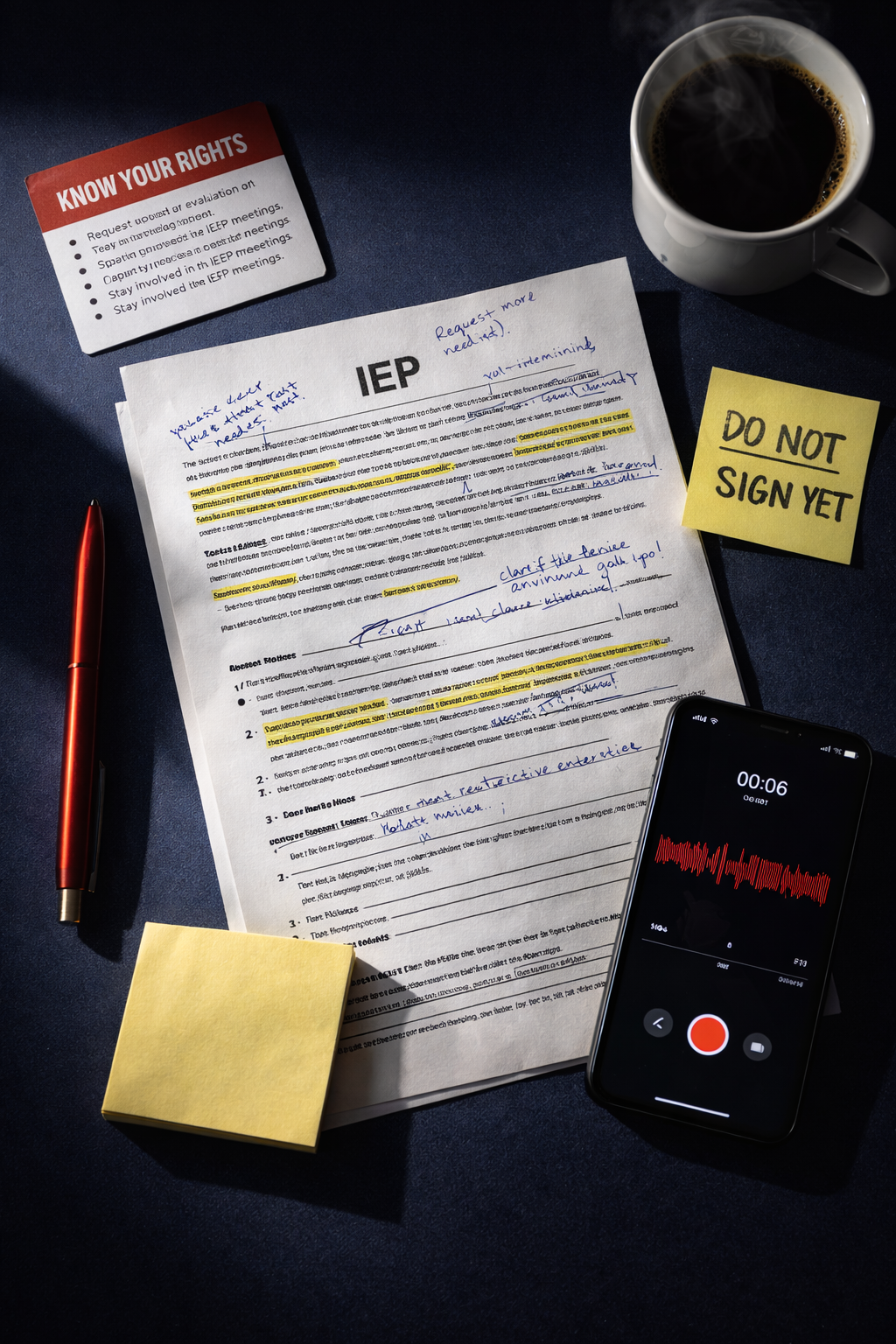
Put it in writing. Email the principal or special education director if your teen doesn't have an IEP yet, or your teen's case manager if they do. Name your teen, their grade, and your specific concern. Writing creates a dated record — and once you sign consent, a federal clock starts running.
If you're reading this at 11pm after another night of missing assignments and a kid who swears everything is fine, you're not behind. Most parents of ADHD teens wait years before asking, because someone told them to give it time, or because their teen is passing and it felt like they hadn't earned the right to ask. You have. Here are the exact words to send.
The power move: don't ask in the pickup line or on the phone. A verbal request is forgettable. A written one is a paper trail the school has to answer. Email is fine — just keep the sent copy.
What's the exact email to send?
Copy whichever fits your situation and fill in the brackets. Send it today; it takes four minutes.
If your teen does NOT have an IEP yet — requesting an evaluation:
Subject: Request for special education evaluation — [Child's full name], grade [X] Dear [Principal or Director of Special Education], I am the parent of [Child's full name], grade [X] at [School]. I am formally requesting a comprehensive special education evaluation for my child under IDEA. I am concerned about [be specific — e.g., incomplete and missing assignments, difficulty starting and finishing work independently, declining grades since [month], and the amount of support required at home to keep up]. My teen has a diagnosis of ADHD. [If applicable: I have attached documentation from Dr. [name].] Please assess all areas of suspected disability, including areas of executive functioning and attention. Please send written confirmation that you received this request, along with the consent form (Permission to Evaluate). I understand the evaluation timeline begins when I return signed consent. Thank you, [Your name] · [today's date] · [phone / email]
If your teen ALREADY has an IEP — requesting a team meeting:
Subject: Request for IEP team meeting — [Child's full name], grade [X] Dear [Case manager's name], I'm requesting an IEP team meeting for [Child's full name], grade [X], to discuss [the reason — e.g., lack of progress on current goals, new concerns about grades, accommodations that aren't being used in class]. I'd like to review [his/her/their] current goals and accommodations and whether they still match what [name] needs. Please let me know dates in the next two weeks that work for the team. I'd like [specific teacher / the school psychologist] included. Please confirm you have received this request. Thank you, [Your name] · [today's date] · [phone / email]
Two small things that matter more than they look: date it, and ask them to confirm receipt. Those two lines are what turn an email into a record.
Who do I send it to?
For a first-time evaluation, address it to the principal or the district's director of special education or student services. For an existing IEP, send it to the case manager named on the current IEP, and consider copying the principal. When you genuinely don't know, send it to the principal and ask them to route it — what matters is that it is written, dated, and received.
What happens after I send it — and how fast?
The school has to respond; a written request can't simply be ignored. Watch for one of two documents: a Permission to Evaluate consent form, or a Prior Written Notice explaining in writing why they're declining and on what basis.
Here's the timing detail almost nobody explains properly. Under IDEA, the initial evaluation must be completed within 60 days of the school receiving your signed parental consent — or within your state's own timeframe, if your state has set one (20 U.S.C. § 1414(a)(1)(C)). Several states are faster; Texas, for example, works in school days rather than calendar days.
The clock starts at your signed consent — not at the conversation you had in the hallway in October. That single distinction is why the written request matters so much, and why you want the consent form in your hands quickly. If you haven't heard anything in about a week, forward your original email with one polite line asking for a status update. The forward is doing quiet work: it timestamps the follow-up too.
What if the school says my teen's grades are fine?
This is the wall ADHD parents hit, and it deserves a straight answer rather than reassurance.
To qualify under IDEA, a student has to meet two conditions: they have a disability, and they need special education services because of it. Schools lean hard on that second condition — and a teen who is passing looks, on paper, like they don't need anything.
But "educational performance" was never defined as the letter grade alone. So don't argue the grade. Document the cost of the grade. That means writing down, specifically:
How long homework actually takes compared to what the teacher assigned
How much of the work is being done by you — the reminders, the sitting beside them, the emails you send on their behalf
Missing assignments, late work, and zeros, even in classes they're passing
What happens when the support is removed for a week
The 8pm shutdowns, the tears, the refusal — and how often
A C-plus that costs three hours a night and a crying kid is not a student who doesn't need support. It's a student whose support is currently unpaid and going home with you. Bring that record, in writing, and the conversation changes shape.
One more thing worth knowing: a teacher's informal screening or a round of classroom interventions is not an evaluation. Those are reasonable first steps, but they are not a lawful reason to stall a clear, written evaluation request.
This is exactly what the IEP/504 Living Document and School Communication Log inside ADHD Vault are built to hold — every dated incident and every email in one place, so when you walk into that meeting the record is already made. But you don't need an app to start: a dated note on your phone tonight is a legitimate record.
Does ADHD even qualify for an IEP?
Yes — most often under the category Other Health Impairment (OHI), which is the route ADHD usually takes into IDEA eligibility, according to CHADD. Some students also qualify under Specific Learning Disability if a co-occurring condition like dyslexia or dysgraphia is present, and a teen can be found eligible under more than one category at once.
If your teen doesn't meet the IDEA bar, a 504 plan is the other door — a different law, a lighter process, and still enforceable accommodations. It is not a consolation prize. We break the difference down in IEP or 504 for ADHD — which does my teen need?
Requesting an evaluation (no IEP yet)Requesting a meeting (IEP exists)What you're asking forWhether your teen qualifies for supportA review or change to the current planSend it toPrincipal or special education directorThe case manager named on the IEPWhat comes backConsent form, or a written refusal (PWN)A scheduled team meetingThe clockStarts when you return signed consentSchools generally schedule within weeksWhen to use itFirst time, or after a new diagnosisGoals aren't working, or needs changed
Why do ADHD teens get missed for so long?
Because the same kid can look fine and be drowning, and middle and high school is exactly where that gap opens.
Russell Barkley's work frames ADHD not as a knowledge problem but as a developmental delay in self-regulation and executive function — the brain's braking and organizing system arriving late rather than not at all. A bright teen can compensate for years through sheer effort and an adult scaffolding they don't control. Then the structure changes: six teachers instead of one, long-range projects, no one checking the planner, and the compensation runs out. Nothing got worse. The demands finally outgrew the workaround.
Which is why "let's wait and see" is such a costly answer at this age. There isn't much runway left before graduation, and the supports your teen learns to use now are the ones they'll carry into college and adulthood.
Frequently asked questions
Can I request an IEP meeting at any time?
Yes. Parents can request a meeting whenever there's a concern — you don't have to wait for the annual review. Put the request in writing, briefly state the reason, and keep a copy of what you sent.
Do I really have to put it in writing?
It's strongly recommended. A written request creates a dated record and starts the school's obligation to respond formally. Email works. If you hand-deliver a letter, ask the front office to date-stamp your copy.
What if the school ignores my request?
Follow up in writing first — forward your original email rather than starting a new one, so the timeline stays visible. If there's still no response, escalate to the district's special education director. Your state's Parent Training and Information Center can advise you at no cost, and an education advocate can step in if you're stuck.
Is requesting a meeting the same as requesting an evaluation?
No. An evaluation request asks the school to assess whether your teen qualifies for support for the first time. A meeting request asks an existing IEP team to review or revise a plan your teen already has. They go to different people and produce different documents.
Does ADHD qualify for an IEP?
Often, yes — usually under the Other Health Impairment category. Eligibility depends on both the diagnosis and whether your teen needs specialized instruction because of it, which is determined by the team using evaluation data, your input, teacher reports, and any documentation from your teen's doctor.
What if the school tells me to wait and see?
Classroom interventions are a reasonable starting point, but they are not a substitute for evaluating a student when a disability is suspected, and they don't override a written request. You can agree to interventions and ask that the evaluation proceed in parallel — say so in writing.
Written by Teresa S., MPH — parent of an ADHD teen, sharing what worked (not a clinician or lawyer).
A note on this article: this is general information for parents, not legal advice. Special education rights come from IDEA and from state law, and timelines and procedures vary by state. For your specific situation, your state's Parent Training and Information Center, an education advocate, or an attorney can help.
You shouldn't have to hold all of this in your head. ADHD Vault keeps your teen's IEP, every school email, and every incident in one place — so the record is built before you need it. Start your 7-day free trial — card up front, then $23.99/month or $239.99/year at the founding price. Cancel anytime.
New here? Meet ADHD Vault · Next: What do I say in the IEP meeting?
Through the hard years, without losing each other.
Sitemap
Get in touch
ADHD Vault is informational and created by a parent with an MPH — not medical, legal, or advocacy advice. See our full disclaimer.© 2026 ADHD Vault


Interested in partnering with us?
We'd love to hear from you! Please reach out at hello@adhdvault.com.