

Parent Resources

If you're raising a teenager with ADHD, you've probably been handed a lot of advice that didn't fit, and a lot of paperwork nobody explained.

This page is the opposite of that. Plain answers, the words the school uses translated into normal English, and a few things you can actually use tonight.

I'm Teresa — a parent of an ADHD teen, and I hold a Master's in Public Health. I speak as a parent first. I share what worked.

THREE THINGS YOU CAN USE TODAY

When it blows up tonight

Before you fix anything, say this out loud:

"This is really hard right now, and I'm right here."

You're not solving it yet. You're telling them they're not alone inside the moment — and a dysregulated brain can't hear anything else until that lands

Before a school meeting

Three questions change how it goes:

1. "Can you show me the data behind that?"

2. "What specifically will change, who is responsible, and by when?"

3. "Can we put that in writing?"

If you have a junior and no college plan

College doesn't carry an IEP forward. Find out what documentation your teen will need for accommodations — and start collecting it now.

What the law actually gives you

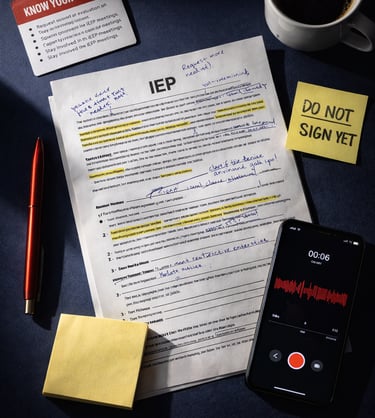
You have more standing than most schools will volunteer. In plain terms:

🌟 You can request an evaluation in writing, at no cost.

🌟 You're a full member of the IEP team — not an observer.

🌟 You can ask for a meeting at any time.

🌟 You're entitled to written reasons if something is proposed or refused.

🌟 You can bring someone with you to any meeting.

🌟 You have a right to your teen's records.

🌟 Put requests in writing. A hallway conversation isn't a record — a short email is.

This is a plain-language explanation shared by a parent, not legal advice. Rules vary by state and district. For anything adversarial, contact your state's Parent Training and Information Center or a qualified advocate.

THE GLOSSARY

What the school actually means

School meetings run on acronyms. Here's what they mean, in normal words.

IEP — Individualized Education Program

A legally binding written plan for a student who qualifies for special education under IDEA. The school is required to follow it. Reviewed at least once a year.

IEP — Individualized Education Program

A legally binding written plan for a student who qualifies for special education under IDEA. It sets goals, services, and supports, and the school is required to follow it. Reviewed at least once a year

Section 504

A federal civil rights law prohibiting disability discrimination in programs receiving federal funding. It's where the 504 plan comes from. Broader eligibility than IDEA, thinner protections.

IDEA — Individuals with Disabilities Education Act

The federal law that governs special education. It's where the IEP, evaluations, and most of your procedural rights come from.

504 Plan

A plan under Section 504 of the Rehabilitation Act for a student with a disability who needs accommodations but doesn't require specialized instruction. Generally lighter than an IEP, with fewer procedural protections — but still legally enforceable.

FAPE — Free Appropriate Public Education

Your teen's right to an education that meets their needs, at no cost to you. The word doing the work is appropriate — not “best available,” which is where most disagreements start.

Evaluation

The formal assessment used to decide whether your teen qualifies for services and what they need. You can request one in writing. It's free.

LRE — Least Restrictive Environment

The requirement that students be educated alongside non-disabled peers as much as is appropriate for them. Removal from the general classroom has to be justified, not assumed.

Evaluation

The formal assessment used to decide whether your teen qualifies for services and what they need. You can request one in writing. It's free.

Accommodation vs. modification

An accommodation changes how your teen learns the same material — extended time, a quiet room, notes provided. A modification changes what they're expected to learn — fewer problems, different standards. Accommodations are far more common for ADHD, and the distinction matters more than most parents are told

Executive function

The brain's management system — starting tasks, organizing, holding steps in mind, shifting between things, managing time and emotion. It's the area most affected by ADHD, and it's why “they could do it if they wanted to” misreads what's happening.

Present Levels (PLAAFP)

The section of the IEP describing where your teen is right now. Everything else is supposed to be built on it, which is why a vague one is worth pushing back on.

Prior Written Notice (PWN)

A written explanation the school must give you when it proposes or refuses a change to your teen's identification, evaluation, placement, or services. If you're told no, you're entitled to it in writing with the reasoning — one of the most useful and least-used rights parents have.

Transition Plan (Transition Services)

The part of the IEP that plans for life after high school — college, work, independent living. Under IDEA it must be in place by the time your teen turns 16, and in some states earlier. It's the most commonly thin section of the whole document, and the one that matters most for the years you're in

FBA and BIP — Functional Behavioral Assessment / Behavior Intervention Plan

An FBA works out what's driving a behavior and what the teen is getting from it. The BIP is the plan built from that. You can request an FBA in writing — and asking for one is often more productive than arguing about a consequence after it's already happened.

Emotional dysregulation

Difficulty managing the size and speed of emotional reactions. Widely recognized as a core feature of ADHD, though not part of the formal diagnostic criteria.

Manifestation Determination

A meeting the school must hold when a student with an IEP faces removal for more than ten days. It decides one thing: was the behavior caused by the disability, or by the school failing to follow the plan? If the answer is yes to either, the discipline can't stand as issued. Few parents know this exists until they need it.

If things feel unsafe

If your teen is in crisis or you're worried about their safety, call or text 988 — the Suicide & Crisis Lifeline. Any time, free and confidential.

THE JOIN BLOCK

This page is a start. The app is the whole system.

The scripts, the school paper trail, the meeting prep, the college plan — in your pocket, and tailored to your teen instead of general advice.

$23.99/month or $239.99/year after your trial

Where else to go

Good organizations doing this work. Use them.

ADDitude

Practical articles and expert Q&A.

Your state's PTI Center

Free help with special-education rights. Every state has one.

Understood.org

Clear explanations of learning differences.

CHADD

The largest national ADHD organization. chadd.org

NIMH

Federal research-based information.