
What do I say when my ADHD teen explodes over nothing?
Why a small thing sets off a huge reaction, the exact words to use while it's happening, what never to say, and how to repair it afterwards without a lecture.
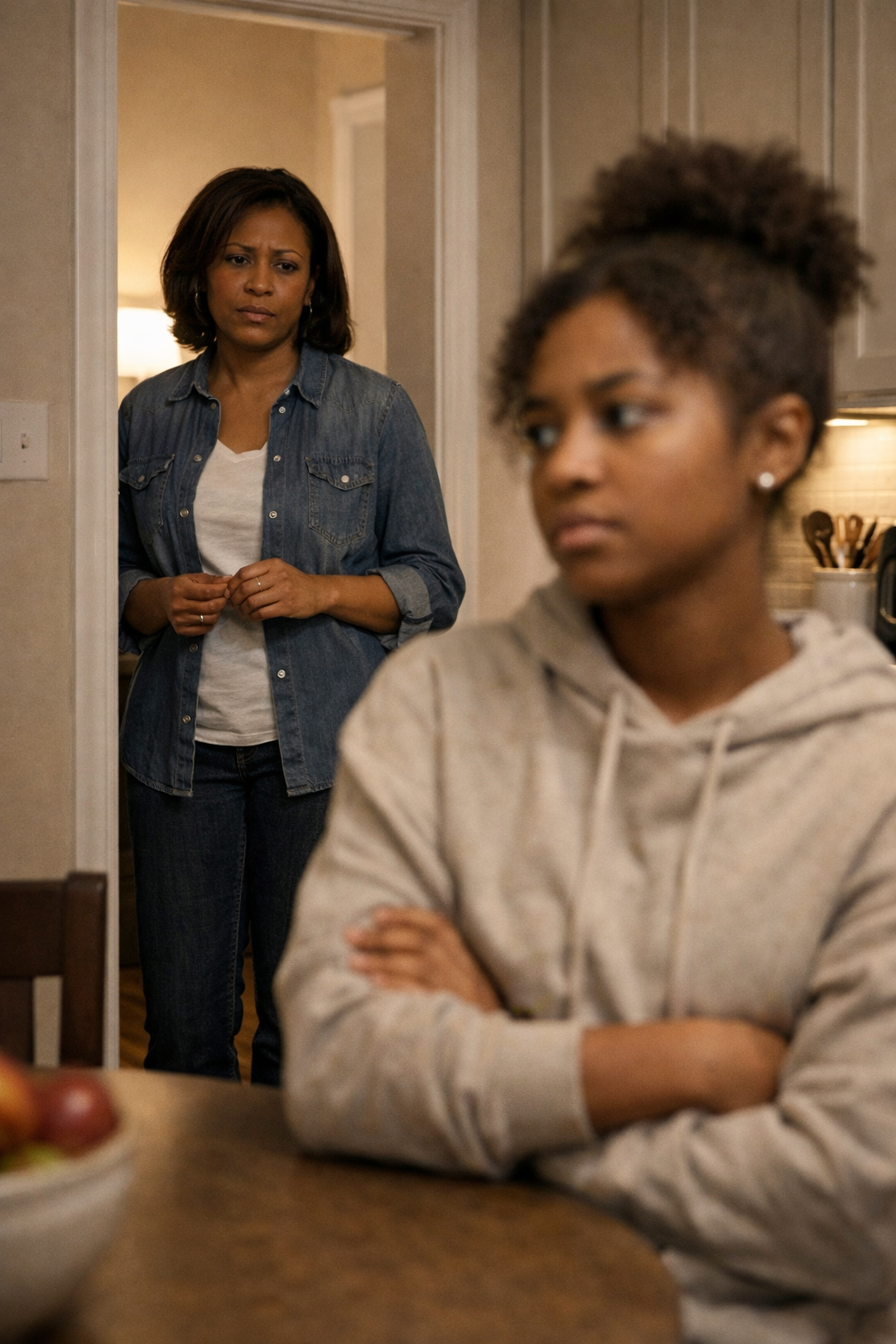

Say less, lower your voice, and don't try to fix it yet. A flooded brain cannot process reasoning, so explaining, defending, or correcting in the moment will make it worse every time. Four words do more than four sentences: "I'm right here." The conversation happens later, once they can actually hear you.
It came out of nowhere. You said something ordinary about the dishes, or the time, or a grade, and suddenly your teenager is furious or in tears or slamming a door, and you're standing in the hallway wondering what on earth just happened. Then, twenty minutes later, they're fine and you're not. If that pattern is familiar, this article is for you, and there is a reason for it that isn't your parenting.
The line to have ready: "I'm right here. We don't have to talk yet." You are not conceding anything. You are telling a nervous system in alarm that it's safe to come down, which has to happen before anything else can.
Why does my teen explode over something small?
Because the size of the trigger and the size of the reaction are not connected the way you'd expect.
Emotional dysregulation is one of the most impairing and least discussed features of ADHD. Feelings arrive fast, land harder than the situation seems to warrant, and take longer to settle. This isn't a character trait sitting on top of ADHD. It's part of the same wiring, and the DSM-5 text revision now recognises quickness to anger, frustration, and overreactive emotionality as features associated with ADHD.
What's happening underneath is a regulation problem rather than a reasoning problem. The prefrontal cortex, which normally moderates the brain's alarm system, is doing that job less effectively. When the alarm fires, less of it gets dampened on the way out. Amy Arnsten's research on stress and the prefrontal cortex describes how quickly that regulating capacity drops offline under stress, in any brain. Your teen's starts closer to the edge.
So the moment your teenager is shouting, the part of them that could weigh your point is the part that's least available. This is why reasoning fails. You are not being ignored. You are talking to a system that temporarily cannot use what you're saying.
Is this RSD, and is RSD a real diagnosis?
Worth answering honestly, because a great deal of what's written about this online is overstated.
Rejection sensitive dysphoria is not a formal diagnosis. It isn't in the DSM-5, there are no standardised criteria for it, and the Cleveland Clinic describes it as a descriptor clinicians use rather than a diagnostic category. The term was coined and popularised by psychiatrist William Dodson to name something he saw repeatedly in ADHD patients: an immediate, intense, disproportionate wave of emotional pain in response to perceived rejection, criticism, or failure.
What is well established is the thing underneath it. Emotional dysregulation in ADHD is extensively documented across the lifespan and is a major contributor to impairment, and in the European diagnostic consensus it's treated as a fundamental feature of the condition rather than an optional extra.
So the useful way to hold it: RSD is a name for a real pattern, not a diagnosis your teen has. That distinction matters when you're talking to a doctor, and it matters when you're reading anything that promises to treat it.
Practically, it explains something parents find genuinely baffling. A mild correction lands as total rejection. A teacher's neutral comment ruins a week. A joke from a friend produces a shutdown lasting days. The reaction is not proportionate to the event because it isn't being generated by the event alone.
What do I say in the moment?
Short sentences. Low voice. No questions requiring analysis.
"I'm right here. We don't have to talk yet."
"You're not in trouble."
"That sounds like it really hurt."
"I'm not going anywhere. Take your time."
"Do you want me closer, or do you want space?"
Notice that none of them ask your teen to explain themselves, justify the reaction, or calm down. Every one of those requests needs the exact capacity that's currently unavailable.
Lowering your own voice does more work than any specific phrase. Regulation is contagious in both directions, and a raised voice will reliably escalate. If you can drop your volume below theirs, you're doing the single most useful thing available.
If they want to be alone, let them be alone. Withdrawal during a flood is often self-regulation rather than rejection, and following them upstairs to finish the conversation almost always costs more than it gains.
What should I not say?
Not "calm down." It has never once calmed anybody, and it communicates that the feeling is the problem.
Not "you're overreacting." True or not, it is heard as your experience is wrong, which lands directly on the thing that just detonated.
Not "why are you like this?" A question they cannot answer, which they will interpret as an answer about themselves.
Not a list of everything else they've done this week. Introducing the wider case during a flood turns a moment into evidence that they are a disappointment.
Not anything requiring them to think. Consequences, negotiations, and reasoning belong later, and stated now they will not be remembered accurately anyway.
What do I do once it's over?
This is the part almost nobody teaches, and it matters more than the words you used during it.
Repair. Once your teen is genuinely settled, which may be an hour or may be the next day, go back briefly. Not to review their behaviour. To restore the connection.
"That got big earlier. I'm sorry I raised my voice."
"I'm not upset with you. I'm on your team, even when it's loud."
"Do you know what set it off? No pressure if you don't."
Repair does something specific for a teenager who already suspects they're difficult to live with. It tells them the relationship survives their worst moments. If the only conversations after a blowup are corrections, they learn that losing control costs them your regard, which raises the stakes on the next one.
And know when not to repair yet. If your teen is still raw, or if you're still angry, wait. A repair attempted too early usually turns into the argument continuing in a calmer voice, which is worse than silence. Wait until you can do it without needing them to concede anything.
One more thing worth doing quietly: keep a note of what actually worked. Which line landed, what time of day it happened, what preceded it. Patterns show up in weeks that are invisible in a single evening, and knowing your own greatest hits is far more useful at 8pm than remembering an article. That's exactly what the Win Tracker in ADHD Vault is for, though a note on your phone does the same job.
How do I stay calm when they're screaming at me?
Honestly: sometimes you won't, and a plan that requires you to be perfectly regulated at all times is not a plan.
What helps is deciding in advance rather than in the moment. Have one sentence you always use, so you're not composing under pressure. Give yourself permission to say "I need a minute" and step into another room, which is modelling regulation rather than abandoning the situation. Slow your breathing out longer than you breathe in, which measurably settles your own alarm system and gives you access to your own judgement again.
And when you do lose it, and you will, that's what repair is for. Your teen doesn't need a parent who never gets angry. They need one who comes back.
When should I get help?
Big emotions are part of ADHD. Some things go beyond that, and are worth taking to a professional rather than managing alone:
Explosions that are escalating in frequency or intensity over months
Anything unsafe, to your teen, to you, or to anyone else in the house
Persistent low mood, hopelessness, or withdrawal that outlasts the incident
Any talk of self-harm or of not wanting to be here, which should always be taken seriously
Your own sense that the household is no longer coping
Start with your teen's doctor, who can look at the whole picture including sleep, mood, and medication. Asking for help early is not an overreaction, and it is not a failure of parenting.
If you are worried about your teen's immediate safety: in the US, call or text 988 for the Suicide & Crisis Lifeline, or text HOME to 741741 for the Crisis Text Line. Both are free, confidential, and available at any hour. If there is immediate danger, call 911.
Frequently asked questions
Why does my ADHD teen overreact to small things?
Emotional dysregulation is a core feature of ADHD. Emotions arrive faster, land more intensely, and take longer to settle, because the prefrontal regulation that normally moderates the brain's alarm response is less effective. The reaction is generated by how the emotion is processed rather than by the size of the trigger.
Is rejection sensitive dysphoria a real diagnosis?
No. RSD is not listed in the DSM-5 and has no standardised diagnostic criteria; clinicians use it as a descriptive term. The underlying emotional dysregulation associated with ADHD, however, is well documented in research and is recognised as a significant source of impairment.
What should I say when my ADHD teen is having a meltdown?
Use short sentences in a low voice and avoid anything requiring analysis. "I'm right here," "you're not in trouble," and "take your time" all communicate safety without demanding that the teen explain or justify themselves. Reasoning, consequences, and problem-solving should wait until they are settled.
Should I follow my teen when they walk away during an argument?
Usually not. Withdrawing during emotional flooding is often a form of self-regulation rather than rejection, and following to finish the conversation tends to escalate it. Let them know you're available and come back when they've settled.
How do I repair things after a bad blowup?
Wait until both of you are genuinely calm, then go back briefly to restore the connection rather than to review the behaviour. Acknowledge your own part, make clear you're not withdrawing your regard, and keep it short. If either of you is still raw, wait longer; an early repair often becomes a continuation of the argument.
Is this happening at school too?
Sometimes, though many teens hold it together at school and release at home. If emotional regulation is affecting your teen's school day, it can be documented and addressed in a school plan; IEP or 504 for ADHD explains which route fits. If the explosions are mostly at home after school, the homework article covers why that happens.
Written by Teresa S., MPH — parent of an ADHD teen, sharing what worked (not a clinician or lawyer).
An important note on this article: this is general information for parents and is not medical advice, diagnosis, or treatment. Emotional dysregulation can overlap with anxiety, depression, trauma, and other conditions that need proper assessment. If your teen's emotional distress is severe, escalating, or persistent, please speak with their doctor or a mental health professional. In the US, the 988 Suicide & Crisis Lifeline (call or text 988) and the Crisis Text Line (text HOME to 741741) are available free and confidentially at any hour.
The right words are hard to find at 8pm. ADHD Vault puts the script on screen in two taps, walks you through steadying yourself first, and keeps a record of what actually worked with your teen, so next time you're not starting from nothing. Start your 7-day free trial — card up front, then $23.99/month or $239.99/year at the founding price. Cancel anytime.
New here? About ADHD Vault · Related: When homework becomes a battle · Mornings with an ADHD teen
Through the hard years, without losing each other.
Sitemap
Get in touch
ADHD Vault is informational and created by a parent with an MPH — not medical, legal, or advocacy advice. See our full disclaimer.© 2026 ADHD Vault


Interested in partnering with us?
We'd love to hear from you! Please reach out at hello@adhdvault.com.