
Building a morning routine for an ADHD teen is not the same as building a morning routine for any teenager. The standard advice — write a schedule, set an alarm, be consistent — skips over every part of the morning that ADHD makes genuinely hard. This guide does not skip those parts.
Disclosure: This post contains affiliate links. If you purchase through these links I may earn a small commission at no extra cost to you. I only recommend products I personally use and believe will help ADHD families.
👉 Start with the free toolkit — 5 downloadable guides for parents of ADHD teens including the Morning Routine Peace guide.
Get it free at adhdvault.com/freetoolkit
No cost. No spam. Straight to your inbox.
Step 1 — Map the Real Morning Before You Build Anything
Before building a routine, you need accurate data on what your current morning actually looks like — not what it should take, but what it actually takes. Observe without intervening for three to five mornings. Time each task your teen completes. Note where the delays happen, which transitions stall, and how much buffer currently exists between the last task and departure.
Most parents discover at this stage that their teen's morning consistently takes 20 to 30 minutes longer than they estimated. Building a routine around the theoretical time rather than the actual time is one of the most common reasons ADHD morning routines fail.
Step 2 — Build Backwards from Departure Time
Once you have accurate timing data, build the routine backwards. Start with the departure time — not the time you would like to leave, the non-negotiable time the bus or carpool arrives. Work backwards through each task, adding the actual observed time plus a 5-minute buffer per task.
This gives you a real wake time that accounts for ADHD transition delays. For most families this is earlier than the current wake time. That conversation about earlier bedtime and the neurological reasons behind it is worth having separately — research on ADHD and sleep from the National Sleep Foundation shows that most ADHD teens need 8.5 to 10 hours of sleep and have a biologically delayed sleep onset, making earlier bedtimes a necessary part of the morning routine fix.
Step 3 — Create the Night-Before Sequence First
The single highest-impact change you can make to an ADHD morning is removing decision-making from it. Every decision removed the night before — clothes chosen, bag packed, lunch made or planned, phone charging location confirmed — is one less initiation demand in the morning.
Create a brief night-before checklist — five items or fewer — and post it where it will be seen. The 10-minute investment the night before consistently reduces morning time by 20 to 30 minutes according to parent reports in ADHD coaching practice and is supported by research on decision fatigue and working memory limitations in ADHD.

Step 4 — Build a Visual Morning Sequence Chart
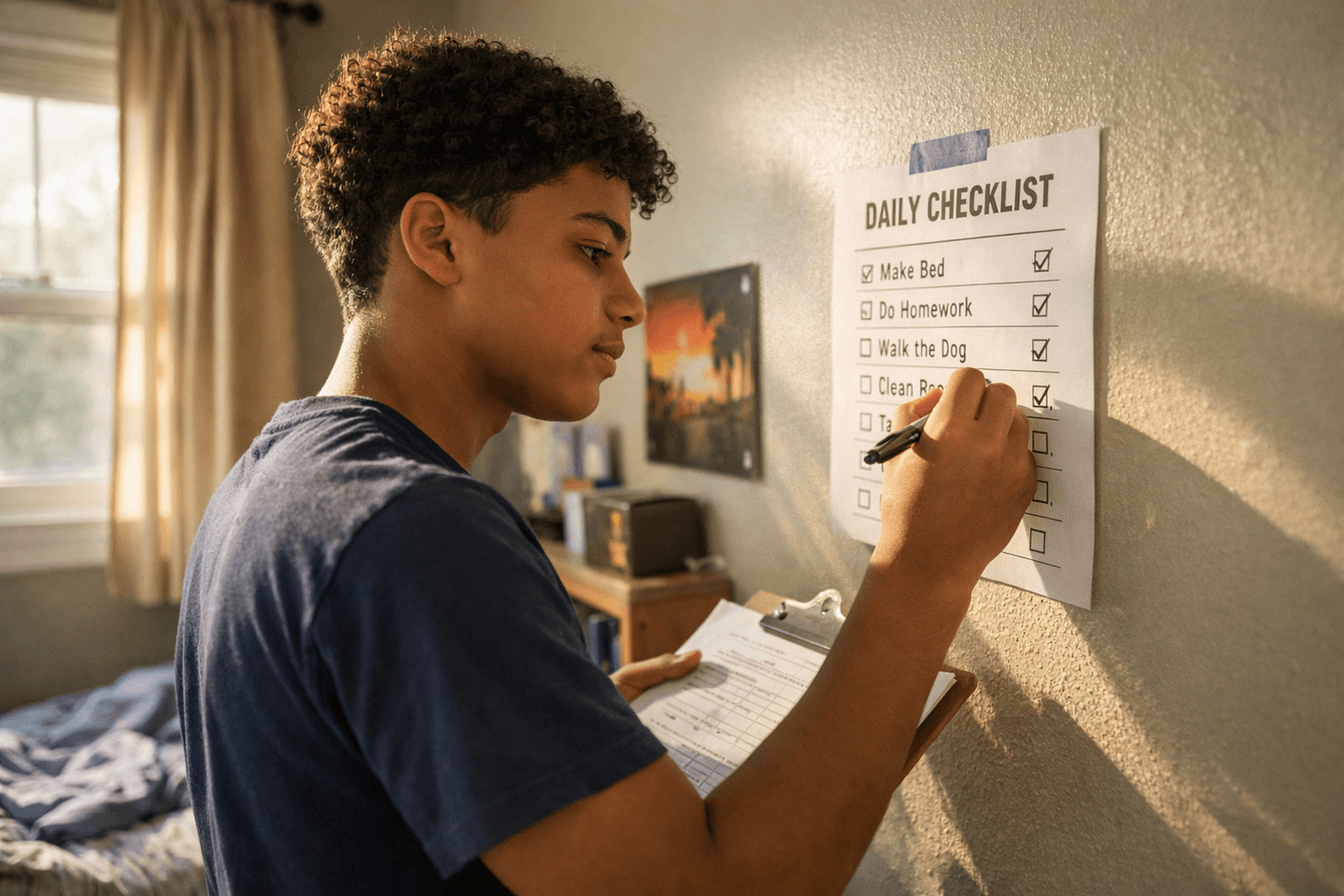
A visual morning sequence chart is the single most consistently recommended tool in ADHD morning routine research and clinical practice. It externalises the working memory demand — your teen checks the chart instead of holding the sequence in mind — and provides a visible record of progress.
Keep it simple: five to seven steps maximum, posted at eye level in the bathroom or bedroom, with checkboxes your teen can physically mark. Photographs work better than words for younger teens. Emojis work well for older teens who resist the childishness of pictures.
The chart does not replace you entirely — you may still need to prompt your teen to check the chart. But prompting your teen to check the chart is fundamentally different from prompting them to do each task. One prompt that hands responsibility to a system versus six prompts that maintain you as the enforcer.
Step 5 — Use Two Alarms With One Non-Negotiable Rule
Set two alarms: a wake-up alarm and a departure alarm. The departure alarm has one non-negotiable rule — at that sound, you walk out the door. Not in five minutes. Not when you have found your other shoe. Now.
This creates a concrete external time boundary that compensates for ADHD time blindness. Research on external time cues in ADHD shows that concrete, immediate deadlines create significantly more urgency response than abstract time warnings. The departure alarm is a concrete, immediate deadline.
Step 6 — Run the Routine for Two Weeks Before Evaluating
New routines do not work immediately for ADHD teens. The executive function system needs repeated exposure to a sequence before it becomes automatic. Research on habit formation in ADHD suggests that new routines take significantly longer to become automatic compared to neurotypical populations — often 6 to 8 weeks rather than the commonly cited 21 days.
Commit to two weeks without significant modifications. Note what is not working but do not adjust until you have consistent data. Then make one change at a time and observe its effect before making the next.
Ready to go deeper? The Morning Routine Peace system walks you through this step by step — video lessons, workbooks, and tools designed for how ADHD brains actually work.
See the full Morning Routine Peace system at adhdvault.com/morningroutine
One-time payment. Lifetime access. 7-day money-back guarantee.
Here is what to remember:
Map the real morning first — build around actual times, not theoretical ones.
Work backwards from departure time to find the real wake time needed.
The night-before sequence removes decision-making from the highest-pressure time.
A visual chart externalises working memory — your teen checks it, you do not carry it.
Two alarms with one non-negotiable departure rule creates concrete time structure.
Want all 5 systems in one place? The Complete Vault gives you everything — Homework Harmony, Morning Routine Peace, Emotional Regulation and RSD, School Advocacy and IEP, and College Prep — for one single payment.
Get Complete Vault Access at adhdvault.com/fullaccess
$147 one-time. All 5 systems. Lifetime access. Save $108 vs buying separately.
Teresa S. is a public health professional, ADHD advocate, and parent of an ADHD teenager. She created ADHD Vault to give parents the evidence-based systems she wished she had.

Evidence-based systems designed for how ADHD brains actually work. Created by an ADHD mom who gets it.
Connect hello@adhdvault.com Response within 24-48 hrs
Large Call to Action Headline
Contact Us
Open Hours
Mon-Fri: 9 AM – 6 PM
Saturday: 9 AM – 4 PM
Sunday: Closed
Location
2 Cruise Park Rise Tyrrelstown
Dublin 15, Ireland
Email: support@systeme.io
Telephone: +1 234 567 890


Secure checkout powered by Stripe • 7-day money-back guarantee
© 2026 ADHD Vault LLC. All rights reserved.