
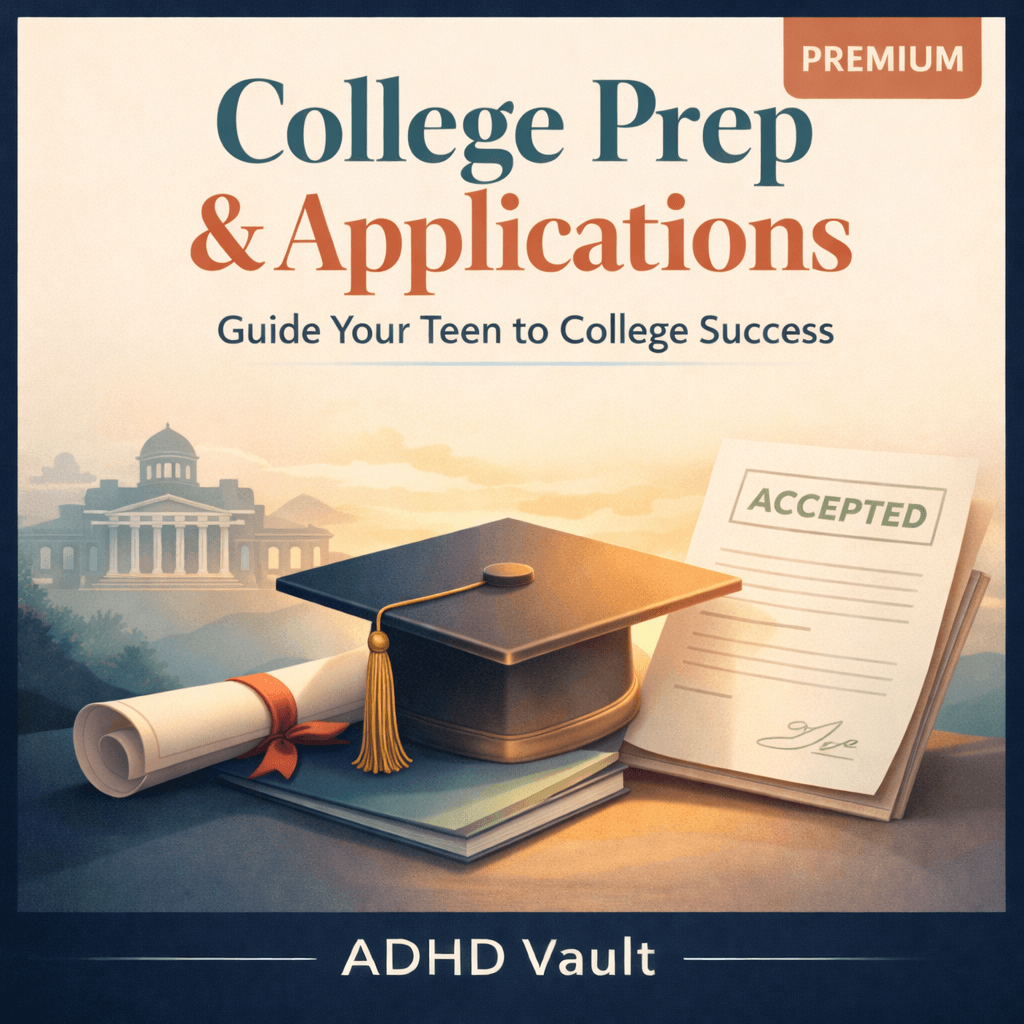
College prep for an ADHD teen is not the same as college prep for any teenager. It involves everything the standard process involves — applications, testing, financial aid — plus a separate layer of planning that most college counsellors are not equipped to help with.
Disclosure: This post contains affiliate links. If you purchase through these links I may earn a small commission at no extra cost to you. I only recommend products I personally use and believe will help ADHD families.

👉 Start with the free toolkit — 5 downloadable guides for parents of ADHD teens including the College Prep guide.
Get it free at adhdvault.com/freetoolkit
No cost. No spam. Straight to your inbox.
That second layer is the one that determines whether your teen thrives at college or spends their first semester in crisis. It involves building executive function skills before they leave home, finding a college environment that supports rather than fights their ADHD, understanding disability services, and planning for the transition in a way that does not happen overnight.
This guide covers both layers — the standard process and the ADHD-specific one.
Starting Earlier Than You Think
ADHD college prep should begin in 9th grade — not because college applications start then, but because the skills your teen needs to succeed in college take years to build. Executive function skills, self-advocacy, independent organisation, medication self-management — these cannot be emergency-installed in 12th grade.
Research from the National Center for Learning Disabilities on college outcomes for students with learning disabilities and ADHD consistently identifies early skill-building as the strongest predictor of college success. Students who arrive at college already knowing how to communicate their needs, manage their time independently, and access support resources significantly outperform those who are trying to learn those skills while simultaneously managing a full college workload.
Finding the Right College Fit — ADHD Matters
Not all colleges are equal in how well they support ADHD students. Research from CHADD on college outcomes for ADHD students identifies several institutional factors that consistently correlate with better outcomes: robust disability services offices, low student-to-advisor ratios, structured first-year programs, access to mental health services, and a campus culture that normalises academic support.
When evaluating colleges, visit the disability services office specifically — not just the admissions office. Ask how many students are registered with disability services. Ask what accommodations are available and how quickly they can be implemented. Ask whether there are ADHD-specific coaching or support programs. The answers tell you more about how well an institution supports ADHD students than any ranking.
The Critical Difference Between High School and College Support
One of the most important things to prepare your teen for is how fundamentally different college disability support is from high school support. Under IDEA, the school was responsible for identifying your teen's needs and providing support. In college, under Section 504 and the ADA, your teen is responsible for self-identifying, self-advocating, and independently arranging their accommodations.
The school will not come to them. They must go to the school. This requires your teen to be able to describe their own ADHD, explain how it affects their learning, and ask specifically for what they need — skills that many ADHD teens have never needed to develop because their parents and schools have handled advocacy on their behalf.
Building Self-Advocacy Skills Before They Leave
Self-advocacy is the single most consistently identified predictor of college success in ADHD students according to research published in the Journal of Postsecondary Education and Disability. It is also the skill parents most often wait too long to develop.
Start transferring advocacy to your teen in 10th or 11th grade. Have them attend IEP meetings. Have them practice explaining their ADHD to a trusted adult — what it looks like for them specifically, what helps, what makes things harder. Have them contact disability services offices directly during college visits, rather than you doing it for them.
Every time your teen advocates for themselves before college, they are building a skill that will protect them when they are doing it without you.
Medication and Healthcare Planning for College
Medication management in college is significantly more complex than at home. Stimulant medications require in-person appointments for prescription renewal in most states — meaning your teen needs a doctor near campus or a telehealth provider who can prescribe in their college's state.
Begin transitioning medication management to your teen in 11th grade. Not handing it over entirely — building shared responsibility. They make their own pharmacy calls. They track when refills are due. They communicate with the prescriber about what is and is not working.
Research on ADHD medication adherence in college students shows that medication non-adherence is one of the most common causes of academic difficulty in the first year of college. Building the habit of self-managing medication before the transition is one of the highest-impact things you can do.
Ready to go deeper? The School Advocacy & IEP system walks you through this step by step — video lessons, workbooks, and tools designed for how ADHD brains actually work.
See the full Morning Routine Peace system at adhdvault.com/college-prep
One-time payment. Lifetime access. 7-day money-back guarantee.
Here is what to remember:
ADHD college prep starts in 9th grade — the skills needed take years to build.
Find a college that supports ADHD — visit disability services, not just admissions.
In college your teen is responsible for their own advocacy — high school support does not transfer.
Self-advocacy is the strongest predictor of college success for ADHD students.
Medication self-management needs to be built before the transition, not after.
Want all 5 systems in one place? The Complete Vault gives you everything — Homework Harmony, Morning Routine Peace, Emotional Regulation and RSD, School Advocacy and IEP, and College Prep — for one single payment.
Get Complete Vault Access at adhdvault.com/fullaccess
$147 one-time. All 5 systems. Lifetime access. Save $108 vs buying separately.
Teresa S. is a public health professional, ADHD advocate, and parent of an ADHD teenager. She created ADHD Vault to give parents the evidence-based systems she wished she had.

Evidence-based systems designed for how ADHD brains actually work. Created by an ADHD mom who gets it.
Connect hello@adhdvault.com Response within 24-48 hrs
Large Call to Action Headline
Contact Us
Open Hours
Mon-Fri: 9 AM – 6 PM
Saturday: 9 AM – 4 PM
Sunday: Closed
Location
2 Cruise Park Rise Tyrrelstown
Dublin 15, Ireland
Email: support@systeme.io
Telephone: +1 234 567 890


Secure checkout powered by Stripe • 7-day money-back guarantee
© 2026 ADHD Vault LLC. All rights reserved.