
Why Mornings Are So Hard for ADHD Teens (It's Not Laziness)
It's 6:45 a.m. You've already reminded your teen three times to get out of bed. One shoe is missing. The backpack isn't packed. Breakfast is untouched. You're watching the clock tick down while your stress level climbs—and the thought creeps in: Why is this so hard every single morning?
If mornings feel like daily chaos in your house, it's tempting to label it as laziness, lack of motivation, or "not caring enough." But for ADHD teens, mornings are genuinely one of the hardest parts of the day. Not because they don't want to do better—but because their brains are working against them.
Once you understand why mornings are so tough, you can stop fighting your teen and start building a routine that actually works.
The Brain Science Behind ADHD Morning Struggles
ADHD morning routine problems aren't about attitude—they're about biology and brain wiring.
Let's break down what's actually happening in your teen's brain between alarm and door.
Delayed Circadian Rhythm
All teens experience a natural shift in their sleep-wake cycle during adolescence—melatonin (the sleep hormone) releases later at night and persists longer in the morning. For ADHD teens, this delay is often even more pronounced.
What this means: Their brains don't fully "wake up" until later in the morning. Asking them to be alert, organized, and efficient at 6:30 a.m. is like asking an adult to function at peak capacity at 3:00 a.m. The drowsiness isn't willful—it's neurological.
Time Blindness
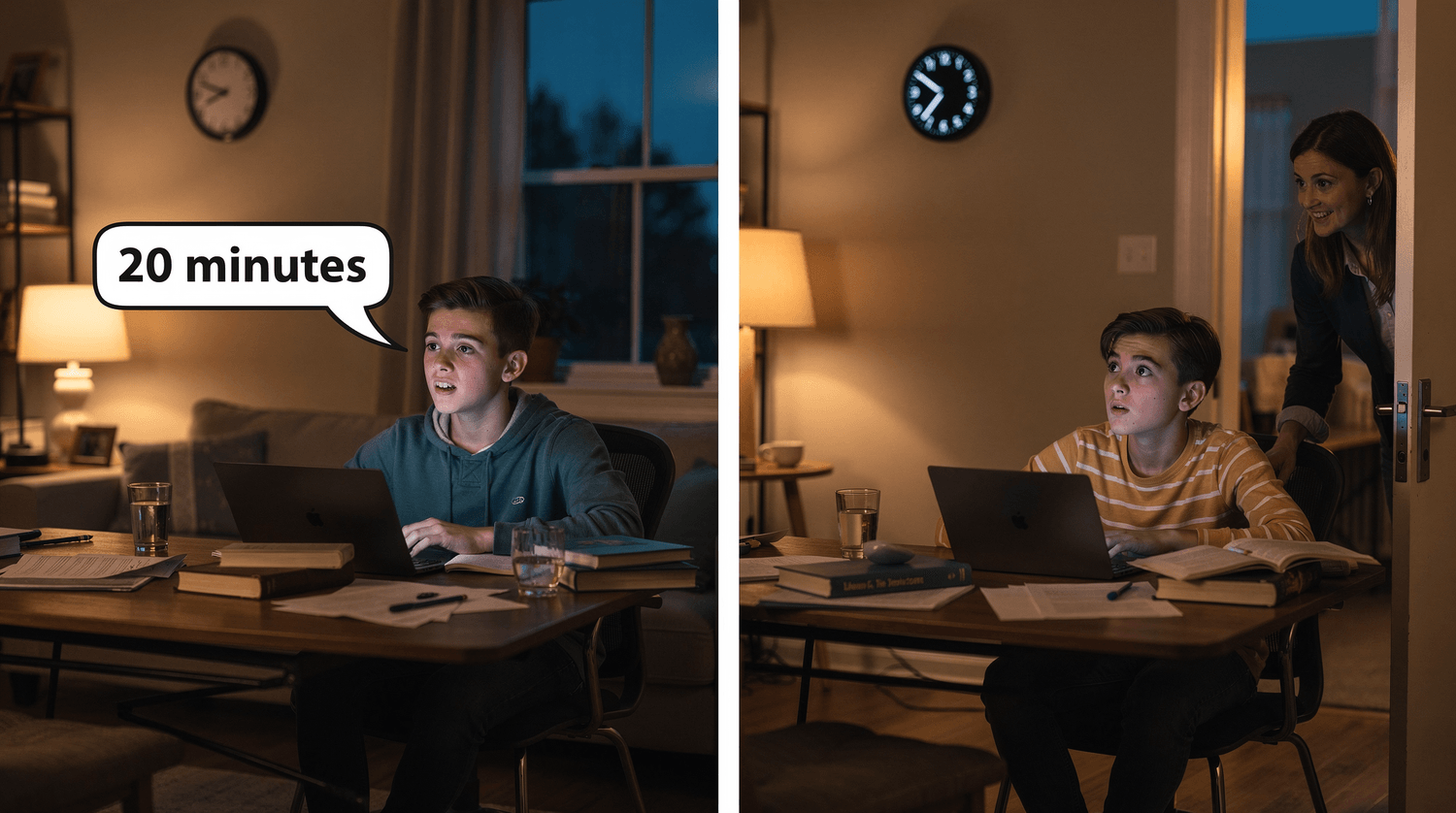
ADHD affects the brain's ability to sense time passing. Time blindness means your teen may truly believe they have "plenty of time," even when the bus arrives in five minutes. They're not lying or procrastinating on purpose—they genuinely cannot feel time the way neurotypical brains do.
Real example: You say, "We leave in 10 minutes." Your teen hears the words but doesn't feel the urgency. Ten minutes later, they're shocked: "Wait, it's time already?"
Executive Function Is Lowest in the Morning
Executive functions—planning, sequencing, prioritizing, initiating tasks—are like the brain's CEO. They help you organize, start, and follow through. For ADHD brains, this CEO is unreliable on the best days. In the morning, before full alertness, executive function is at its absolute weakest.
That's exactly when school mornings demand the most: remember everything, make decisions, follow a multi-step sequence, manage time, regulate emotions when things go wrong.
It's a mismatch. The task demands are highest when the brain capacity is lowest.
Medication Timing (If Applicable)
For teens who take ADHD medication, mornings often happen before the medication has taken effect. That means they're navigating the most demanding part of their day with the least support.
Note: This isn't medical advice—just context many parents recognize. If medication timing is a factor, that's a conversation for your prescriber.
Working Memory Overload
Working memory is like a mental sticky note—it holds information while you use it. "Get dressed, pack your bag, eat breakfast, brush teeth" requires holding multiple steps in mind simultaneously. ADHD brains struggle with this, especially when tired.
What happens: Your teen starts getting dressed, sees their phone, forgets they were getting dressed, ends up in a YouTube spiral in pajamas at 7:15.
Put it all together: mornings are a perfect storm of low energy, poor time awareness, weak executive function, and high demands. No wonder everyone's frustrated.
Why Traditional Morning Advice Fails ADHD Teens
Most morning advice assumes a neurotypical brain. For ADHD teens, it often backfires or creates more stress.
"Just Wake Up Earlier"
This advice assumes more time = less chaos. But earlier wake-ups don't fix executive function challenges—they just add sleep deprivation, which worsens attention, emotional regulation, and impulse control. Your teen ends up more dysregulated with more time to spiral.
Invisible Checklists
"Get ready for school" sounds simple, but it hides dozens of micro-steps:
Wake up
Turn off alarm
Get out of bed
Go to bathroom
Brush teeth
Shower
Get dressed (remember what to wear)
Make breakfast
Eat breakfast
Pack backpack
Find shoes
Get coat
Check for keys/phone/wallet
Leave on time
ADHD teens often get stuck between steps because they can't hold the sequence in working memory or don't know what comes next.
Too Many Decisions
Every decision drains executive function. Mornings that require multiple choices—what to eat, what to wear, what to pack—create decision fatigue before the day even starts.
Examples:
"What do you want for breakfast?"
"What should you wear today?"
"Did you pack everything you need?"
Decision overload first thing in the morning leads to shutdown, distraction, or meltdown.
When systems rely on memory, motivation, or willpower, mornings become battlegrounds. ADHD brains need external structure, not internal drive.
What Actually Works for ADHD Morning Routines
The goal isn't perfection—it's predictability, less stress, and gradual independence. These strategies work with ADHD brains, not against them.
1. Create a "Departure Station"
A Departure Station is a single, dedicated place where everything needed to leave the house lives. No exceptions.
What goes there:
Backpack (packed the night before)
Lunch or lunch money
Sports gear or instruments
Charger
Keys
Jacket/coat
Why it works: Eliminates morning scavenger hunts. Your teen knows exactly where to go to grab everything. One location = less executive load.
Real example: One family uses hooks by the front door with a small table underneath. Everything lives there. Morning routine dropped from 45 chaotic minutes to 20 focused minutes.
Pro tip: Set it up together the night before. This becomes part of the evening routine, not morning stress.
2. Use Backwards Planning (Reverse Timeline)
Instead of saying, "We leave at 7:30," which feels abstract, work backwards from departure time and make it visible.
Example:
7:30 – Out the door
7:25 – Shoes on, backpack grabbed
7:20 – Backpack check (phone, charger, homework)
7:10 – Breakfast finished
7:00 – Dressed
6:50 – Shower/hygiene done
6:40 – Out of bed
Post this on the wall. Use big numbers. Make it impossible to miss.
Why it works: ADHD teens do better when time is seen, not assumed. A visual timeline externalizes the sequence so they don't have to hold it in working memory.
3. Rely on Visual Timers, Not Verbal Reminders
Verbal reminders ("Hurry up!" "You need to leave in 5 minutes!") sound like nagging. Timers externalize time and reduce power struggles.
How to use them:
One timer for getting dressed (10 minutes)
One for eating breakfast (15 minutes)
One "wrap-up" warning timer (5 minutes before departure)
The timer becomes the cue—not you. This shifts responsibility from parent to system.
Recommended tools:
Visual countdown timers (Time Timer brand)
Phone alarms with custom labels
Alexa/Google Home timers with verbal cues
Why it works: Takes you out of the enforcer role. The timer is neutral. No one argues with a timer.
4. Use Body Doubling
Many ADHD teens function better when someone else is nearby—not managing them, just present.
What this looks like:
Drink your coffee at the kitchen table while they eat breakfast
Fold laundry in the hallway while they get dressed
Do your own morning routine in parallel
You're not hovering or micromanaging. Your presence provides external regulation that helps them stay on task.
Why it works: The ADHD brain struggles with self-directed attention. Another person's presence creates accountability without words.
5. Limit Morning Choices
Prepare decisions in advance so morning executive function isn't drained by decision-making.
Reduce choices:
Lay out 2 outfit options the night before (or have a school uniform)
Offer 2 breakfast options max ("Cereal or toast?")
Pack backpack the night before (no morning decisions about what to bring)
Fewer choices = less overwhelm = faster, calmer movement.
Why it works: Decision-making requires executive function. Removing unnecessary decisions preserves cognitive energy for the tasks that actually matter (getting out the door on time).
6. Build in Buffer Time
If your teen needs to leave by 7:30, aim for 7:20. ADHD brains struggle with transitions and unexpected delays (lost shoe, forgotten homework, sudden bathroom emergency).
Buffer time = breathing room = less panic when things go sideways.
A Real Parent Shift That Changes Mornings
One parent shared that once they stopped lecturing and started using a visual checklist plus a Departure Station, mornings went from daily meltdowns to "mostly manageable."
Her exact words: "I realized my job wasn't to motivate my daughter—it was to design the environment. Once I stopped trying to make her care more and started removing obstacles, everything shifted."
What she did:
Moved to a visual checklist on the bathroom mirror
Set up a Departure Station by the door
Used a Time Timer instead of verbal reminders
Let natural consequences happen (missed the bus = school calls, not Mom's problem)
Within two weeks, her daughter was getting herself out the door with minimal input. Not perfect—but 80% better.
That shift—from motivating to designing—makes all the difference.
The Complete System
If mornings feel like a daily survival test, the Morning Routine Peace System gives you a simple, step-by-step setup designed specifically for ADHD teens.
Inside, you'll get:
Visual routines your teen can follow independently
Night-before systems that eliminate morning chaos
Time tools and timers that replace nagging
Scripts to reduce conflict and increase cooperation
Troubleshooting guides for common morning obstacles
It's not about doing more—it's about doing less, better. Structure that supports, not stress that depletes.
Ready for Calmer Mornings?
👉 Download the free Morning Reset Guide to start resetting your mornings with ADHD-friendly tools tonight.
Then explore the Morning Routine Peace System ($37) to build a routine that actually works—without yelling, rushing, or resentment.
Mornings don't have to be perfect. They just need the right system.
© 2026 ADHD Vault. All rights reserved. No part of this content may be reproduced, distributed, or transmitted without prior written permission. Contact hello@adhdvault.com for licensing inquiries.
Ready for the Full System?
Get all 5 complete systems with 40+ video lessons and 25+ workbooks.

Evidence-based systems designed for how ADHD brains actually work. Created by an ADHD mom who gets it.






Connect hello@adhdvault.com Response within 24-48 hrs
Secure checkout powered by Stripe • 7-day money-back guarantee
© 2026 ADHD Vault LLC. All rights reserved.

Evidence-based systems designed for how ADHD brains actually work. Created by an ADHD mom who gets it.
Connect hello@adhdvault.com Response within 24-48 hrs
Large Call to Action Headline
Contact Us
Open Hours
Mon-Fri: 9 AM – 6 PM
Saturday: 9 AM – 4 PM
Sunday: Closed
Location
2 Cruise Park Rise Tyrrelstown
Dublin 15, Ireland
Email: support@systeme.io
Telephone: +1 234 567 890


Secure checkout powered by Stripe • 7-day money-back guarantee
© 2026 ADHD Vault LLC. All rights reserved.