
Why ADHD Teens Struggle with Homework (And What Actually Works)
1. Executive Function Delays (Task Initiation)
Executive function is like a mental project manager—it helps someone start, plan, and follow through. For many ADHD teens, this manager is notoriously unreliable. Even when the intention is there, getting started feels like lifting weights with a toothpick. Opening a Google Doc can be the mental equivalent of climbing Everest.
2. Working Memory Challenges
Working memory is the brain's sticky note system—holding pieces of information long enough to use them. ADHD brains often struggle to keep instructions in mind. Your teen might hear "read chapter three and answer questions 1–5" and walk away remembering only "read chapter three." They may look at a worksheet and forget the first step by the time they start the second.
3. Emotional Regulation Difficulties
Homework isn't just cognitive—it's emotional. Frustration, boredom, anxiety, and shame can escalate quickly for ADHD teens. A math problem that feels impossible can trigger avoidance, meltdown, or humor as defense. What seems like procrastination is often emotional self-preservation..
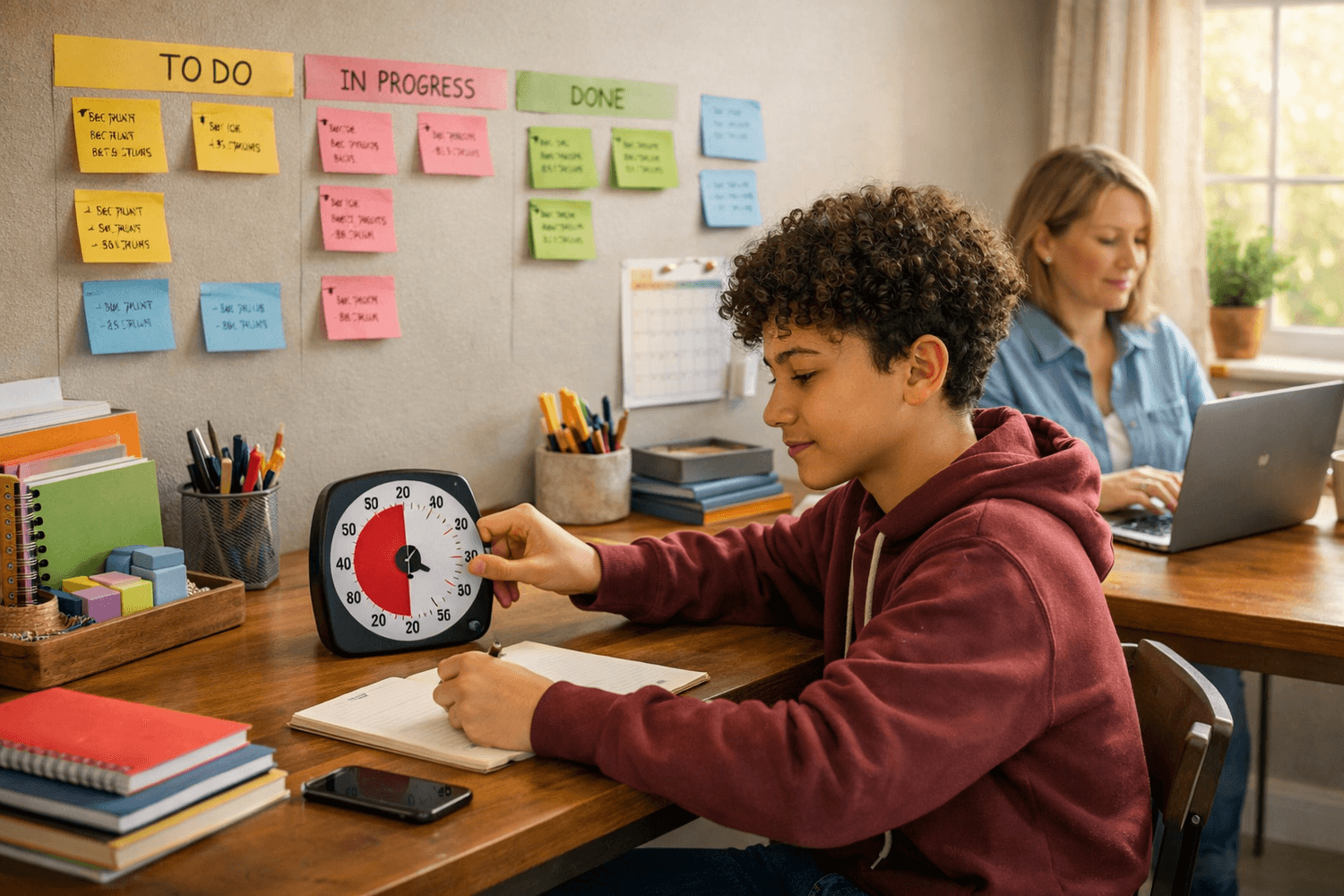
What Actually Works
Let's get practical. These aren't vague life-coaching slogans—they're parent-tested strategies that help ADHD teens navigate homework with more confidence and less conflict.
Strategy 1: Body Doubling
Body doubling means working in the presence of another person. This doesn't mean you hover with a stopwatch. It means your teen does homework while you (or a sibling, tutor, or friend) work on your own tasks nearby.
Why it works: ADHD brains function better with external structure and social accountability. Having someone in the room provides subtle cues that support attention and follow-through.
Example: Set a 25-minute homework window. You sit with your knitting or emails while your teen tackles algebra. No commentary, no reminders—just shared focus. When the timer dings, celebrate the completed block with a high-five or stretch break.
Tip: This works at home, in a library, or over video call with a friend who's also working on their own tasks.
Strategy 2: The 15-Minute Timer Method
Long homework sessions feel impossible. But short bursts—15 minutes—feel doable.
How to use it:
Set a timer for 15 minutes
Your teen picks one task
Work until the timer goes off
Then take a 3–5 minute break
This isn't about perfection—just momentum
Why it works: The ADHD brain responds to immediate deadlines. A 15-minute commitment feels achievable and reduces overwhelm. Over time, these mini sessions build stamina and confidence.
Example: Math first: 15 minutes. Break (dance, dog petting, snack). Then English: another 15 minutes. Before you know it, two assignments are done without a single "get started" showdown.
Tip: Use a visual timer (like a sand timer or timer app with animation) so your teen can see time passing—it makes the abstract more concrete.
Strategy 3: Visual Task Breakdowns
Homework directions like "write your essay" are too broad for many ADHD teens. Breaking tasks into micro-steps transforms vague goals into actionable steps.
How to do it: Use sticky notes or a whiteboard to list steps such as:
Read prompt
Brainstorm 5 ideas
Pick a topic
Write intro paragraph
Break for 3 minutes
…etc.
Why it works: Breaking tasks into visible, bite-sized chunks reduces executive load. Each check-off releases a small dopamine hit—your teen gets rewarded for progress, not just completion.
Example: For science homework:
☑ Review notes
☑ Write answers to Q1–3
☑ Check work
Seeing steps checked off builds momentum and reduces "Where do I start?"
Tip: Color-code tasks by subject or difficulty to add visual clarity.
Strategy 4: Choice and Autonomy
ADHD teens are more engaged when they feel in control. Instead of assigning the order of tasks, offer choices.
Examples of choices:
"Do you want to start with math or English?"
"Would you like to work at your desk or the kitchen table?"
"Timer first: 15 or 20 minutes?"
These sound small, but they flip the dynamic from "You must" to "You choose."
Why it works: Choice increases intrinsic motivation. When teens feel heard, they're more likely to engage without resistance.
Example: Your teen dreads reading. You offer: "Do you want to start with 15 minutes of reading now, or after you finish your quiz?" They pick, they feel empowered, and homework moves forward.
Tip: Limit options to two or three, so choices feel manageable instead of overwhelming.
Strategy 5: Dopamine Boosters (Movement, Music)
ADHD brains are wired for novelty and stimulation. Movement and music can increase dopamine—the brain chemical linked to focus and reward.
Movement breaks:
Jumping jacks before math
A quick walk after Spanish vocab
Ball toss while memorizing vocab
Music hacks:
Instrumental playlists
White noise or lo-fi beats
Headphones to reduce distracting household sounds
Why it works: Physical activity and preferred sensory input help regulate energy and create readiness for cognitive work.
Example: Your teen plays 3 minutes of favorite music while reviewing flashcards, then switches to a calmer playlist during writing. Movement before tasks reduces restlessness and improves attention.
Tip: Let your teen help craft their "study playlist" or movement ritual—ownership increases participation.
The Complete System
If these strategies sound helpful but you're wondering how to make them stick, we've built a system that turns them into a repeatable routine. The Homework Harmony System was created for parents like you who want structure—not stress—for homework time.
Inside you'll find:
8 video lessons that walk you and your teen step-by-step through strategies that work with an ADHD brain (not against it)
5+ printable workbooks for task breakdowns, planning, and reflection
Step-by-step parent guides to implement body doubling, visual task maps, timer techniques, and more
Real examples from families who transformed homework from conflict to cooperation
Homework Harmony isn't about perfect homework nights—it's about making progress, reducing stress, and helping your teen feel capable and supported.
Ready to Transform Homework Time?
Ready to change homework time from friction to flow? Start with your free Homework Reset Guide! It's packed with simple steps you can use tonight—no overwhelm, no heavy prep.
👉 Download your free Homework Reset Guide now.
And when you're ready to go deeper, check out the Homework Harmony System—our complete toolkit for ending homework battles with confidence ($37).
You deserve homework peace, and your teen deserves strategies that honor how their brain works.
Let's make homework time calmer, clearer, and more connected—together.
What's the Hardest Part of Homework in Your House?
We'd love to hear from you! What homework struggle is hitting hardest right now? Is it getting started, staying focused, managing meltdowns, or something else entirely?
Share your experience in the comments below—you're not alone, and your story might help another parent feel less isolated.
© 2026 ADHD Vault. All rights reserved. No part of this content may be reproduced, distributed, or transmitted without prior written permission. Contact hello@adhdvault.com for licensing inquiries.
Ready for the Full System?
Get all 5 complete systems with 40+ video lessons and 25+ workbooks.

Evidence-based systems designed for how ADHD brains actually work. Created by an ADHD mom who gets it.






Connect hello@adhdvault.com Response within 24-48 hrs
Secure checkout powered by Stripe • 7-day money-back guarantee
© 2026 ADHD Vault LLC. All rights reserved.

Evidence-based systems designed for how ADHD brains actually work. Created by an ADHD mom who gets it.
Connect hello@adhdvault.com Response within 24-48 hrs
Large Call to Action Headline
Contact Us
Open Hours
Mon-Fri: 9 AM – 6 PM
Saturday: 9 AM – 4 PM
Sunday: Closed
Location
2 Cruise Park Rise Tyrrelstown
Dublin 15, Ireland
Email: support@systeme.io
Telephone: +1 234 567 890


Secure checkout powered by Stripe • 7-day money-back guarantee
© 2026 ADHD Vault LLC. All rights reserved.